
53°21′00″N 06°15′37″W
On 12 May 1803, Michael McGlynn and a very pregnant Catherine Collins arrived in Sydney from Ireland on the Rolla. They had been convicted of taking an illegal oath by joining the United Irishman in Dublin in 1801. For the next five generations through the 19th and 20th centuries, each of my McGlynn male ancestors married an Irish Catholic woman until I broke the mould in 1981 by marrying a French woman.
So, it seemed like a good idea to visit Ireland. Dublin because it is the capital, Cork because Michael McGlynn was born there and Galway because it made a nice triangular trip around the country. From all I had heard about Ireland from my family traditions and from the Irish Brothers at Patrician Brothers Fairfield, I was expecting an obviously catholic country – if a little more secularised over recent years – one with the Catholic St Patrick everywhere to be seen. I was also expecting Guinness and music.
I had no preconceived idea of what Dublin or Ireland would be, but from the moment I stepped off the ferry from Cherbourg, I felt I had landed somewhere else. The people were lovely, and helpful as I have heard from many others, but the town did not appear to have a centre and to me did not feel Irish – even though I did not know how Irish felt. I was not even prepared for it to be a port city even though I was arriving by ferry.

Trinity Bar
Things started to settle down after we had found our accommodation and set off to see Dublin. We walked into Trinity Bar. I had previously associated Trinity in Catholic countries with some of the higher institutions, and the combination with the name Bar had conjured up an expectation of it somehow being the legal precinct, just down the road from Trinity College. I could not have been more wrong. It is the entertainment district, and in Dublin that means pubs which open up in time for a late lunch served with Guinness.

Then for my next surprise. I had not even thought about food in Ireland, but a small island surrounded by wild ocean must have good seafood, and it did. But it has also had a basically rural economy for centuries and as a result produced high quality ingredients and the ability to put them together brilliantly. I loved the food. My sisters laughing at me from the other side of the world said it was just because it was like my mother used to make. Perhaps, but her Irish stew was never as good as this one, and her shepherds pie didn’t match any of the many I tried along the way. The potatoes were good, and found in a wider variety of preparations than the ubiquitous chips we found in Belgium a few years ago.


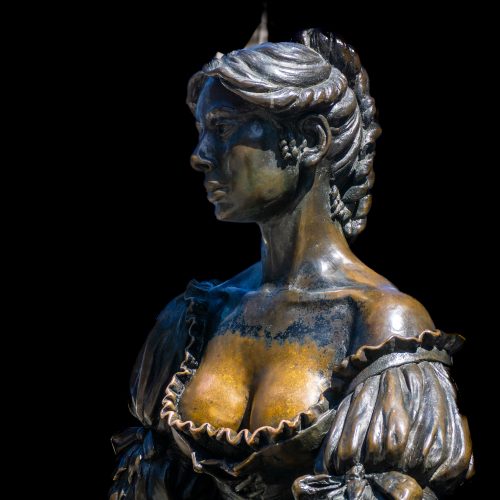
After our first lunch, served by a young man from Brisbane on a gap year, we walked out to see the shape of the city. Of course, there is the Moly Malone Statue, which the tourists rub for good luck, but from the polish marks on the bronze, not on the nose like the pig statue in Macquarie Street in front of Sydney Hospital!

A Protest
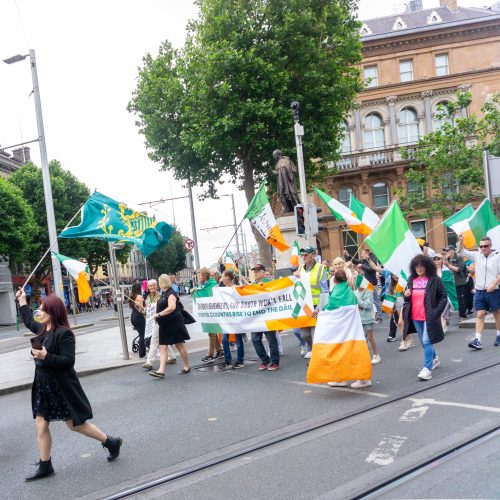
During our explorations we came across a protest winding its way down the street. Ever keen to understand the local events, we started asking the people marching past what the protest was about. We were handed a pamphlet on excess deaths from covid and a call for an enquiry. But the next person told us it was about illegal immigrants, and another thought it was about calling for a United Ireland. Yet the banners were protesting against Michael Martin, Taoiseach, who some felt was a traitor for supporting abortion law reform in the referendum a few years ago. So, we concluded that it was a general purpose demonstration and that not many passers-by were taking much notice. While watching the protest, we saw our first (of many) signs warning of the perils of going cashless!


Music
On the first night we decided to find some Irish music in a pub. All our investigations led us to the Cobblestone on the corner of King Street and Red Cow Lane. It was lauded as authentic. We arrived early and found a table at one end of the bar and shared it with some Canadians. We bought a Guinness and chatted for a while until we realised that it was around seven thirty, and the music was meant to start at seven pm. I went to ask at the bar but, just in time, saw a corner at the other end of the bar where a group of musicians had gathered and had been playing a range of different tunes between themselves. It was not a performance for a packed bar, but instead a meeting of musicians playing together. It was traditional, amazing and entertaining, but not what I had expected. You can see us in the mirror if you look closely!

We found a more performance based show on the next night and heard a range of the old Irish standards and other music from the sixties to the nineties performed by a couple of sixty year old Irishmen who had the whole place hanging off every word and note!
St Patrick and his Cathedral
On day 2 in Dublin, we decided to start with St Patrick’s cathedral. Ready to have all my prejudices confirmed, I was shocked to my socks on walking in and finding that it was the headquarters of the Church of Ireland (local brand of the Church of England) and that St Patrick was a shared saint. It was only then that I started to understand that Ireland had been an English colony for several hundred years and only an independent state for less than one hundred years. All the institutions bore the English stamp with an Irish flavour, and the consensus was to live with the duality that comes with that history in the modern world.

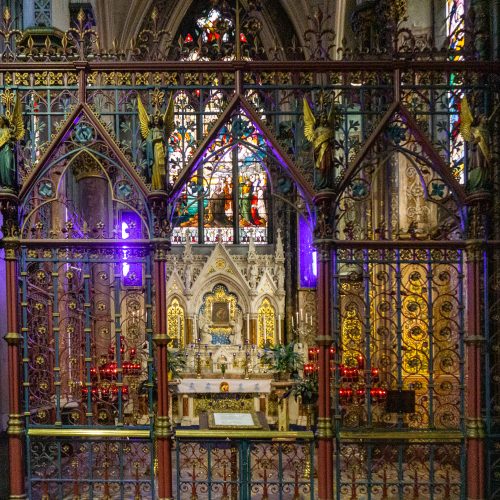
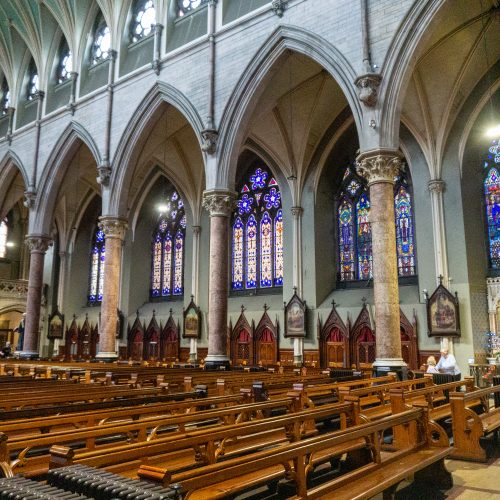
It took me another full day before I found a Catholic church of any significance, and fittingly it was just down the road from the Guinness Brewery.

The Guinness Brewery

It seems like a compulsory tour to visit the Guinness Brewery in Dublin. There is nothing more Irish than Guinness. However, my expectations were low. What’s in a brewery, after all? Again, I was wrong about Ireland. The tour was beautifully put together with a very informative historical presentation, full information about the brewing process, production of barrels, delivery around the world, the quality of the Irish barley, and the secret to the colour – all in the barley roasting so it seems. The exhibition of advertising down the years was revealing of the development of Irish society over that time, with the target market broadening to take in everyone, including women. The highlight, however, was the gate and the walk around the historic buildings which date back nearly 200 years.
Trinity College and the book of Kells
Apart from being the premier university in Ireland, and well recognised internationally, Trinity College becomes tourist fodder because it is home to the Book of Kells, a richly illustrated bible which began life in Kells and worked its way to Trinity College by chance in an attempt to protect it from destruction. Unfortunately, it is not possible to photograph the real book, but there are plenty of illustrations around the exhibition to show the detail of the work.

One emerges from the Kells exhibition to find the Trinity College Library. It is smaller than I had expected and is under renovation. The books are being completely reviewed and restored as necessary. Fortunately, they are being removed in sections, leaving some on display. There are also some wonderful finds. Of course there is Shakespeare, but as part of a process to correct the lack of female representation in the statues around the library, Mary Wollstonecraft appears. A worthy recipient of the honour, but a little more special to me as we live in Wollstonecraft in Sydney named after her cousin who came to Australia to avoid being coloured by her reputation!


Another great exhibit is the Brian Brou Harp. It is the harp which was used as the model for the symbol of Ireland which is now everywhere. I was pleased to see it named after a Brian. He was, after all, the king of Ireland around 1000AD who all the Brians in Ireland are named after.
The GPO
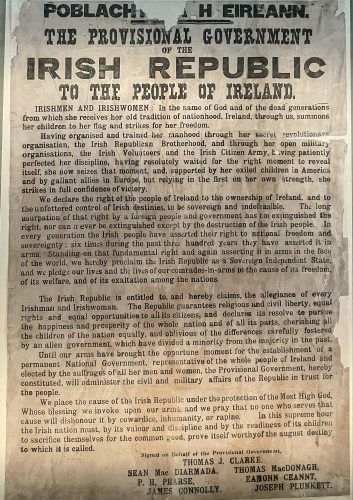
It took us some time to find our way to the GPO, the scene of the Easter Rising in 1916, and our expectations were not high. Again wrong. A great exhibition which gave us a solid insight into the background of the rising and the events which played out in that famous place. Again beautifully presented.
Dublin Castle
We did not know what Dublin Castle was but with a name like that it seemed important. Just a little hat tip to our lack of preparation! For those as poorly informed as me, Dublin Castle is the building that was constructed to house the British Government in Ireland. It was originally built in 1204 as a medieval defensive structure following a decree by King John of England on the site of a Viking settlement and was extensively remodeled and extended in the 18th Century into a Georgian palace to demonstrate grandeur and political power. It was the home of the Viceroy of Ireland and ceremonial rooms for major government events prior to Irish Independence.
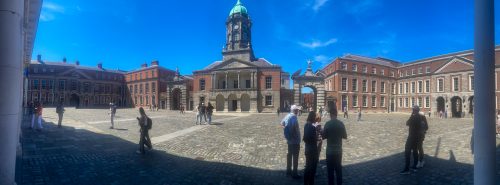
The highlights were the Viking ruins which have been excavated under some of the Medieval Castle, and the guide. The guide, an Irish woman from Waterford expressed her gratitude for British Rule and the construction of the Castle, because as a result of that she had a job. She made it clear though, that her gratitude extended no further. She was entertaining and knowledgeable and provided insights into the still raw feelings the Irish have for the British, only one hundred years after independence.


Culture
Before leaving Australia we asked Google Gemini how best to see and understand Irish life. Apart from Guinness and music it recommended that we visit a bookshop to find some current works by famous Irish authors and to buy and read some local newspapers. We found Chapters bookshop and asked for some advice. We found novels which the staff said were representative of current culture and spent the next few days reading about child sexual abuse, murder, abortion reform stories and all the big issues that have been concerning the locals over the last few years.
Moving on to newspapers we bought a copy of the Irish News which turned out to be more focused on Belfast. I was shocked to see the front page devoted to a plan by the IRA to defend a street against a loyalist parade which did not happen thirty years ago. The headline made it seem like a recent event.

Conclusion
It took me a little time to get my head around Ireland. Its still strong British flavour left me a little taken aback. But after a few days in Dublin, I started to see, and taste, the Ireland underneath. A guiness or two and a shephards pie and an Irish stew, a few nights of Irish music and the underlying humour in everything set me on the right path for the rest of the visit, starting with a trip to Cork.

Wow! That was a great read Brian and entertaining as well
Thanks! I had not realised we did so much in Dublin!
Glad you broke the mould although Irish and Norman are pretty similar especially when compared to the English.
Great read and waiting for the next episode on Cork
Xxxx
Awaiting the next episode now! I’m hooked! An enjoyable and entertaining read 😃
Thanks Brian – a very enjoyable read and I have learnt a bit about Ireland. I will add Ireland to my list of places to visit.